Valentine's Day in Historic Mississauga
/
Painting of Saint Valentine by Italian artist Jacopo Bassano from around 1575 from Wikimedia Commons.
Valentine's Day did not always arrive in red-wrapped packaging or involve fancy dinner reservations for two. In historic Mississauga, February 14th was a quieter occasion, yet it held deep significance. During the long, cold winter days spent indoors with family and daily chores, Valentine’s Day in mid-February offered a welcome moment of warmth and anticipation. In the communities that once formed historic Mississauga, Valentine’s Day unfolded not through spectacle, but through paper, print, and public gathering. To understand what the holiday meant locally, we must look not only at its broader origins but at how love was expressed within the rhythms of community life.
Where the Holiday Began
This well-known holiday can trace its origins to a mixture of ancient Roman traditions and later Christian observances honoring St. Valentine. Very few reliable facts exist about the historical Saint Valentine, and his story remains shrouded in uncertainty. He is believed to have been a martyr, sentenced to death for his Christian beliefs around the year 270, likely on February 14th, the day now celebrated as his feast. However, early Christian sources mention multiple martyrs named Valentine, making his identity unclear. Over time, devotion to St. Valentine spread, and his feast day was widely observed, though there is little historical evidence directly linking him to romance. The association between February 14th and love seems to have developed later, especially in Medieval England, when writers like Geoffrey Chaucer connected the day with courtship. By the eighteenth and nineteenth centuries, exchanging written messages and decorated cards became a popular tradition, shaping Valentine’s Day into its present form.
Unlike today’s highly commercialized celebration, Valentine’s Day in historic Mississauga was understated. Expressions of affection were shaped less by advertising and more by the personal effort of handwritten notes and shared community experiences.

Ad from the Feb 14, 1935 issue of the Streetsville Review.
Love in a Small Community
Valentine’s Day in historic Mississauga was especially meaningful because it was deeply celebrated within the local community. Courtship and new relationships were not private matters; they unfolded at church bazaars, winter gatherings, and Valentine’s Day dances in local halls. Affections were witnessed and supported by neighbors who had known each other for generations. The local newspaper reflected this interconnected world. Engagements and newlywed couples were announced plainly but proudly, carrying excitement throughout the township. Love was not just a private exchange; it helped shape families and the wider community. While affection was central, partnership also meant shared responsibilities and pooled resources, crucial in a rural landscape. Valentine’s dances, social gatherings, and printed announcements were more than seasonal events; they publicly marked lives becoming intertwined.
Today, Valentine’s Day often feels personal and commercial, filtered through advertisements and curated images. In historic Mississauga, however, love was rooted in community. Dancing to fiddle music in crowded halls, shared in newspapers, and saved in family scrapbooks. It belonged not only to couples but to the wider community that celebrated and supported them.
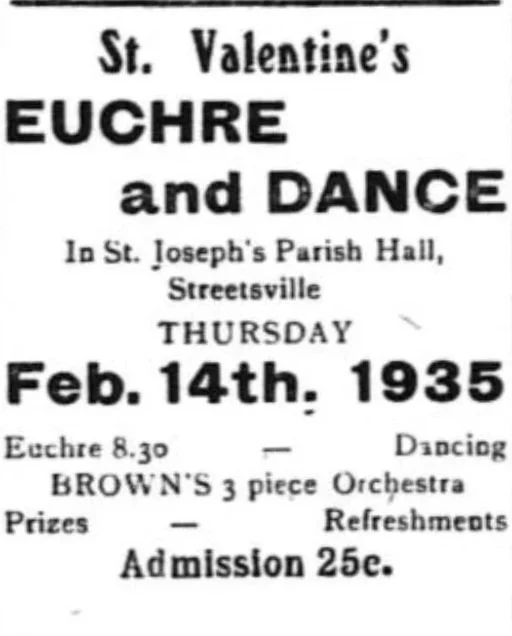
Ad from the Feb 14, 1935 issue of the Streetsville Review.
The Sentiments of Valentine's Day
To send a valentine was to risk hope; to receive one was to feel seen in a tightly knit community. Handwritten letters and carefully designed Valentine’s cards carried a depth of meaning often lost amid today’s elaborate gifts and advertisements.
Exchanging Valentine’s cards was one of the most common ways to observe the holiday. By the late nineteenth and early twentieth centuries, decorative cards trimmed with lace or sentimental verses were available at general stores. Some preferred to write their own messages, choosing words that balanced sincerity with propriety. Children exchanged simple cards at school, while young adults sometimes used the occasion to signal new romantic interest. Whether playful or heartfelt, these cards carried significance. In a small community, even a modest Valentine could boldly and meaningfully declare affection.
Today, fragments of these sentimental exchanges survive as handwritten notes, calling cards, engagement clippings, wedding announcements, and studio portraits. They remind us that expressions of affection were once slower, more intentional, and deeply connected to community life. These keepsakes, preserved in family homes and formal archives, show that Valentine’s Day was more than a seasonal tradition—it was part of a larger story.
While Valentine’s Day has changed over the years, its legacy in historic Mississauga endures. Love was not hidden or fleeting; it lived in church halls, winter dances, and the columns of local newspapers. Brief announcements and handwritten valentines became cherished keepsakes, reminding us that love has always been at the heart of this community. When we open these fragile pieces of paper, we are not just reading history, we are witnessing the beginnings of lives that helped shape Mississauga today.