
How GTA Buildings Are Becoming More Accessible Than Ever
/
How GTA Buildings Are Becoming More Accessible Than Ever
Walk into almost any modern office building, hospital, or public facility in the Greater Toronto Area today and you’ll notice small features that make a big difference: push-button doors, wider entrances, smoother pathways, and signage designed for easier navigation.
For many people, these details blend into the background of daily life. But together they represent a quiet transformation in how buildings across the GTA are being designed and upgraded.
Accessibility is no longer viewed as a specialized feature for a small group of people. Across the Greater Toronto Area, it is increasingly considered a fundamental part of how modern buildings are designed, upgraded, and operated. From large office towers to community centres and retail spaces, accessibility improvements are becoming a defining feature of modern urban design across the region.
Why Accessibility Is Becoming a Priority
Several factors are driving this shift.
First is legislation. Ontario’s Accessibility for Ontarians with Disabilities Act (AODA) has played a major role in shaping how public and commercial spaces are designed, influencing building standards, accessibility upgrades, and renovation practices across the province. The goal of the legislation is to remove barriers and create environments that allow people with disabilities to participate fully in everyday life.
But regulation alone doesn’t explain the change.
Demographics are also playing a role. Canada’s population is aging, and communities are increasingly focused on ensuring buildings remain usable and comfortable for people at every stage of life. A workplace, hospital, or retail space that is easier to navigate benefits not only individuals with disabilities, but also seniors, parents with strollers, delivery workers, and employees moving equipment or materials.
As a result, accessibility is increasingly seen as good design, not simply compliance.
The Small Design Changes That Matter Most
Many accessibility upgrades are subtle. They rarely dominate the architecture of a building, but they significantly improve how people move through it.
Automatic and Push-Button Doors
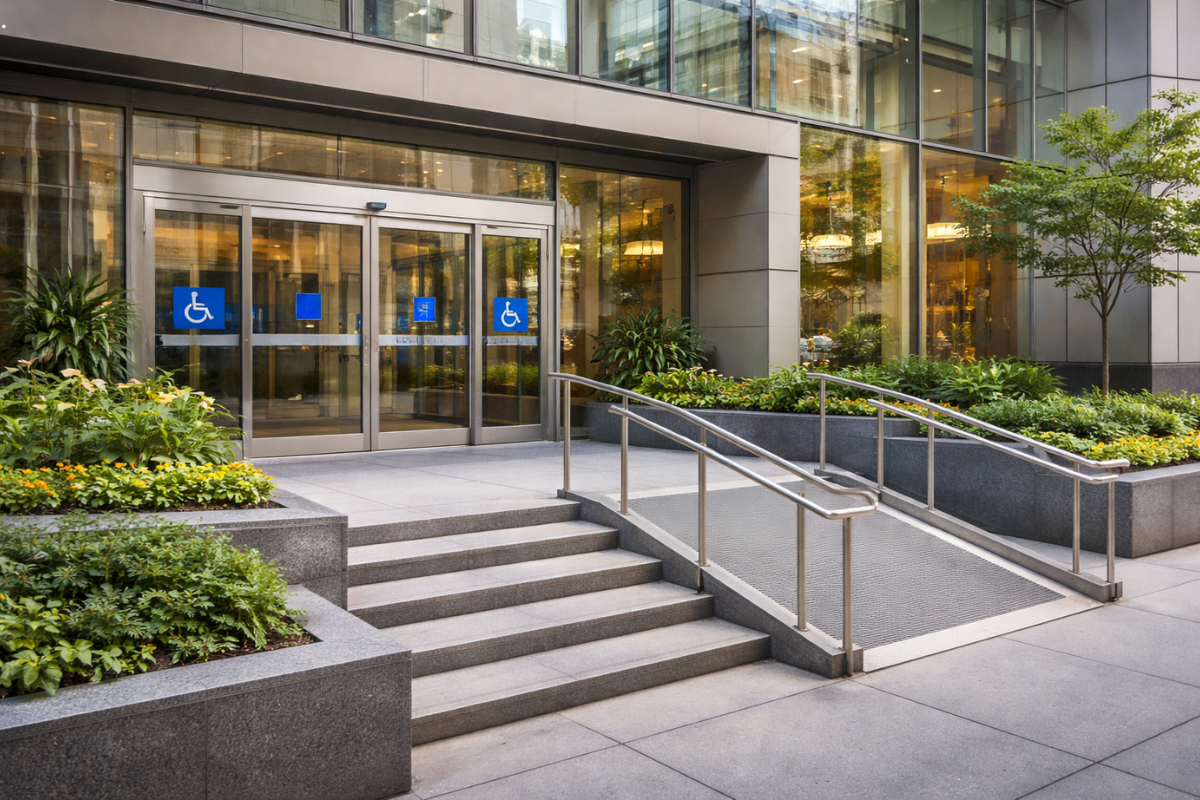
One of the most visible improvements across the GTA is the rise of automatic or push-button door systems. These allow people with mobility challenges to enter buildings independently and safely.
They’re now common in offices, hospitals, schools, and shopping centres. Beyond accessibility, they also improve convenience for anyone carrying bags, pushing carts, or navigating busy entrances.
Barrier-Free Door Hardware
Another important change involves the hardware on doors themselves.
Traditional round doorknobs are increasingly being replaced with lever handles that require less grip strength to use. Door closers are often adjusted so doors require less force to open, while entryways may be widened to accommodate wheelchairs and mobility devices.
These changes may appear minor individually, but together they remove everyday barriers that once made buildings difficult to navigate.
Accessible Entrances and Pathways
Building entrances have also evolved.
Modern developments often integrate ramps more seamlessly into the design of the main entrance rather than placing them as secondary access points. Interior layouts are increasingly designed to reduce tight corners, steps, or narrow corridors that can make navigation challenging.
Across the GTA, newer buildings are being designed with accessibility in mind from the start, while older buildings are gradually being retrofitted to improve accessibility.
Accessibility in High-Traffic Buildings
Accessibility improvements are especially important in buildings that serve large numbers of people every day.
Office towers, hospitals, universities, transit-connected developments, and major retail centres must accommodate thousands of visitors, employees, and customers daily. Even small barriers can quickly become major obstacles when multiplied across large crowds.
Designing accessible entryways, corridors, elevators, and emergency exits helps ensure these spaces function smoothly for everyone who uses them.
Professionals who work with commercial door hardware and accessibility systems often emphasize that these upgrades must be carefully designed to maintain both usability and safety.
Lock-Up Services, a GTA-based commercial locksmith and barrier-free systems specialist, shared a similar perspective when asked about the role these systems play in modern buildings:
“Barrier-free systems are really about removing friction from everyday spaces. When entrances, door hardware, and automatic operators are designed properly, people shouldn’t have to think about accessibility — the building just works for everyone. At the same time, those systems still have to integrate with security hardware and life-safety exits so the building remains both accessible and secure.”
Accessibility Benefits Everyone
One of the biggest misconceptions about accessibility upgrades is that they are only useful for a small portion of the population.
In reality, accessible design improves everyday convenience for nearly everyone.
Automatic doors make it easier for parents with strollers to enter a building. Wider pathways help people carrying boxes or equipment move more freely. Lever door handles are easier for someone with a temporary injury or limited grip strength.
In many ways, accessibility improvements simply make buildings easier to use.
This broader benefit is one reason accessibility features have become increasingly common in modern commercial developments.
The Future of Accessible Buildings in the GTA
Accessibility improvements are continuing to evolve as technology advances and building standards adapt.
New developments are beginning to integrate touchless entry systems, smarter access controls, and automated door technology that improves both accessibility and security. Older buildings across the GTA are also being gradually upgraded to meet modern accessibility expectations.
Urban planners, property managers, and building owners increasingly recognize that accessibility is an essential part of creating spaces that work well for the communities they serve.
As the region continues to grow, these improvements will likely become even more widespread.
A More Inclusive Built Environment
Accessibility is often most successful when people barely notice it.
The push-button doors, accessible entrances, and thoughtfully designed pathways found in modern buildings may seem like small details, but together they create environments that allow more people to move through spaces safely and independently.
Across the Greater Toronto Area, those small details are quietly reshaping how buildings function — making workplaces, public spaces, and commercial environments more inclusive than ever before.