Remembering Mississauga’s Marie Therese Coenegrachts
/
Marie Therese Coenegrachts, William Perkins Bull Collection, Region of Peel Archives.
The courage, valour, and abiding nationalism demonstrated by the young men of historic Mississauga are celebrated and memorialized in many way – Cenotaphs, War Memorials, Honour Rolls, family memorials and plaques to name a few. But this story of remembrance is different: tt explores an obscure account of unbounded heroism that unfolded in Belgium, but came to be linked to Mississauga, specifically Cooksville. This is an account of a most remarkable woman named Marie Therese Coenegrachts.
When German troops invaded Belgium in 1914, Marie Therese was a beautiful, dark-eyed girl in her early 20s. She was born in 1890, and her family lived in a large country house on the River Meuse close to the Dutch border. The stately home had some 33 rooms, and this caught the attention of German officers who commandeered the home as their residence and forced Marie Therese and her mother to manage housekeeping. Marie’s young husband was a solider, who was later captured. Day-to-day contact with headquarters staff gave Marie Therese an opportunity to assist the Allied cause.
Marie Therese entered Allied secret service as Operator XO-1 and proved to be a highly efficient agent. Knowing full well that she could be executed for treason, as was nurse Edith Cavell for aiding in the escape of Allied soldiers, Marie Therese agreed to take command of the Belgian espionage system in occupied territory. Marie Therese was responsible for the organization of 25 agents who reported on German troop movements, plans and strength, and negotiated the escape of Allied troops caught behind enemy lines.
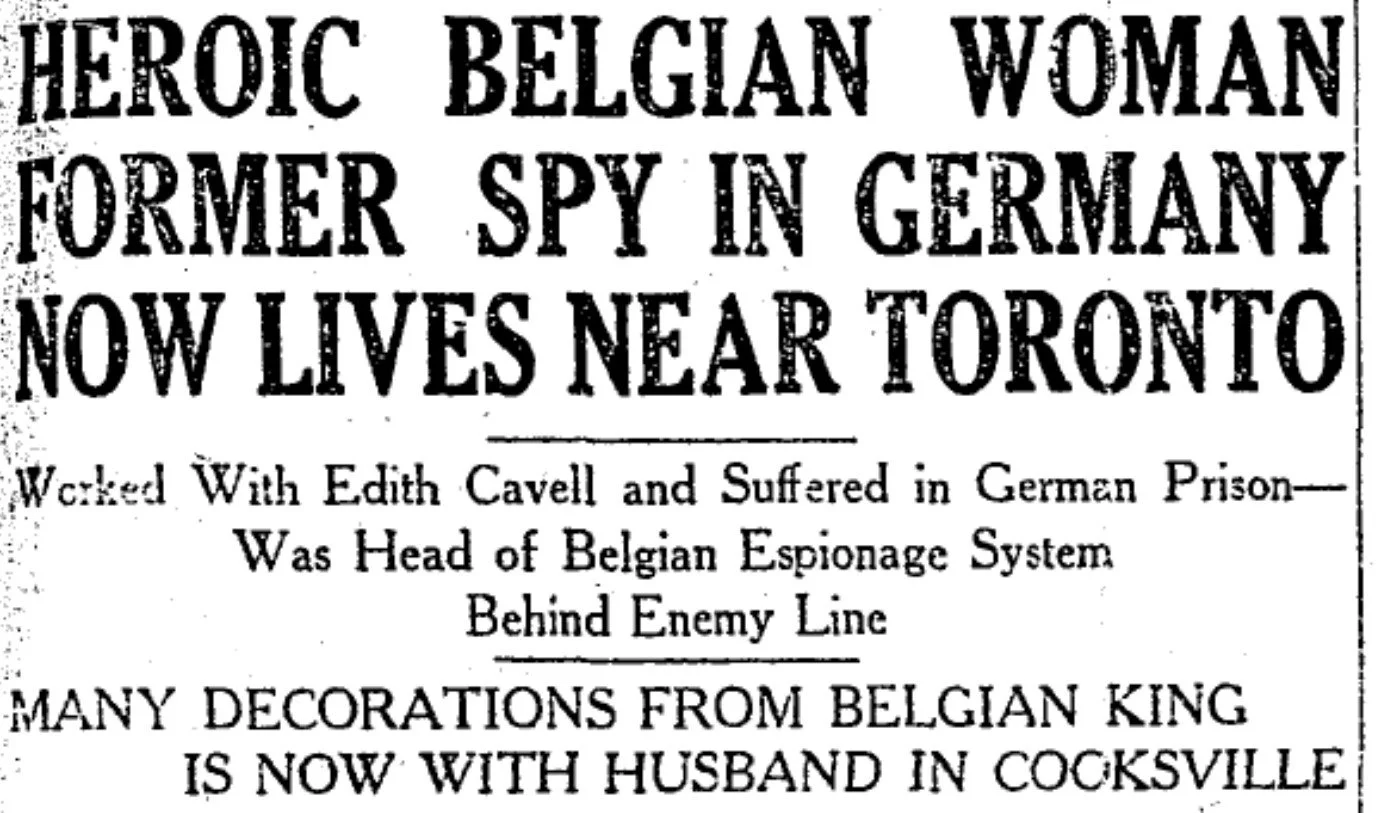
From the Toronto Daily Star headline, December 17, 1925.
In an interview with The Toronto Daily Star, her husband Gaston remarked that Marie Therese’s work in Belgium was “almost superhuman.” She exhibited an astonishing innate ability to evade the enemy without raising suspicion, a talent partly attributed to her near-native fluency with the German language as instructed by her childhood governess. The value of the information stolen from the grasp of the enemy was immense as it provided the Allies with insightful details for developing strategy and minimizing loss.
Marie Therese’s world of espionage unravelled amidst a plot to blow up a strategic aqueduct and railway line at Verviers. It was mere days before the planned explosion when she was given up by one of her most trusted agents. A German officer and three soldiers broke into her Verviers home in the middle of the night and placed her under arrest. Marie Therese was prepared to sacrifice her life rather than betray her agents and her country. She was condemned to death on a fixed date of February 19, 1917. After brutal abuse at the hands of German prison guards, she collapsed and fell unconscious, completely drained from the physical, emotional and mental torment of her interrogation. As she was no longer of use in an unconscious state, she was sent to a German hospital where doctors performed two operations and nursed her back to health. It is said that for seven weeks she was unable to speak a single word.
Through a plea from Desire-Joseph Mercier, Belgian Cardinal of the Roman Catholic Church, her death sentence was commuted to life imprisonment. When at last the war was over, she was released. Marie Therese had played a significant role in the war effort, and after the war many of her compatriots were suspicious of her connections to the German military. She insisted on a public enquiry and more than 80 witnesses came forward to testify on her behalf. It was then that her accomplishments and sacrifices became known.
Marie Therese never fully recovered from her injuries. Weary of war, she and her husband, Captain Gaston (Marcel) Coenegrachts, made the decision to begin new lives in Canada. In 1925 Gaston followed his friend, Baron Jean Kervyn de Lettenhove, to Cooksville. Baron Kervyn had purchased land close to Dundas Street and established a successful fox ranch. The Coenegrachts purchased an adjacent property and entered the fur business as well, breeding silver-coated foxes and minks for their luxurious and fashionable furs – they called their farm “Golden Sunshine Ranch”. Locals knew the Coenegrachts as Mary and Marcel. It is recorded that Captain Coenegrachts gave prizes to the Cooksville Fall Fair, showing he was engaged and known in the community.
Marie Therese Coenegrachts’ exceptional war work was recognized in Belgium by the Order of Leopold, the Civic Cross of the First Class, and the “Medal of the Condemned Politician”. On December 17, 1925 The Toronto Daily Star headline ran “Heroic Belgian Woman Former Spy in Germany Now Lives Near Toronto”. In the interview with her husband about Marie Therese’s wartime deeds and subsequent treatment by the enemy, the article states that “… an almost legendary figure in Belgium, Madame Marie Therese Coenegrachts has received every decoration for bravery the King of the Belgians can confer upon her, and she has earned them all and more.” Further newspaper references in 1933 and 1934 also recount her experiences and trials, while also referring to her continued poor health.
In “From Brock to Currie” by William Perkins Bull (1935): “It is not generally known that here in Peel there lives a former member of the Belgian secret service, Madame Coenegrachts of Cooksville …while her husband was a prisoner in Germany she was at home recruiting veteran engineers and secretly securing dynamite from Holland to blow up communications useful to the enemy.”
The property that the Coenegrachts purchased on September 21, 1927 for their farm was part of Lot 16, Concession 1, NDS (North of Dundas Street), consisting of 11.62 acres, as well as part of the adjacent Lot 17. Their property was located a short distance north of Dundas Street, stretching along what is now Hillcrest Avenue near Confederation Avenue. The Coenegrachts purchased their property from Jessie and Leopold Roumegous, and this land was formerly part of the Claire House Vineyard / Canadian Vine Growers Association property. The Coenegrachts tenure here was relatively short lived as the Roumegous’ were involved in court proceedings over a dissolved partnership and land, and when they sold to the Coenegrachts, the Roumegous’ ownership was contested. The court ultimately found in favour of plaintiff, and the property was sold in late 1934. After this, it is unclear where Marie Therese and Gaston Coenegrachts lived next, and we do not currently know when they passed away or where they were ultimately laid to rest. At the moment, we have not found any references to them after 1934.
If you have more information on Marie Therese and Gaston Coenegrachts and their time in historic Mississauga, and after, we would love to hear from you!
Special thanks the Mississauga Library System for the original article.