Modern Entrepreneur Profile: Mississauga's Amina Djirdeh
/In conversation with Amina Djirdeh, recipient of the Mississauga Starter Company Plus grant.
1. What does your company provide/do?
Global Mastery Partners helps organizations turn inclusion from a compliance checkbox into a competitive advantage. We work with universities, finance firms, and community organizations to build genuinely inclusive cultures—using data and systems, not platitudes.
We treat inclusion like a finance problem: we audit hiring data, promotion patterns, and performance reviews—the infrastructure where exclusion lives. Then we work with leadership to ensure accountability, train managers who run day-to-day systems, and measure results. We also deliver financial literacy programs for underserved communities, because financial empowerment is foundational to meaningful inclusion.
We don't sell buzzwords. We deliver outcomes.
2. What inspired you to start your company?
I was 19 when a career counselor looked at me—a young Black woman—and said four words: "Finance isn't for you."
Not cruel. Just factual. She looked at me and concluded I didn't belong.
Those four words became my inadvertent decade-long experiment in how systems actually work. I spent the next ten years breaking into Bay Street—investment banking, equity research, and private equity. I earned my MBA from Rotman. I did the work. I exceeded expectations.
And that's when I realized: the system wasn't broken. It was designed this way.
My mistakes were magnified. My victories were questioned. I wasn't playing the wrong game—I was playing the right game with the wrong rules.
I founded Global Mastery Partners because I got tired of waiting for insiders to fix systems they benefit from. Because exclusion isn't personal—it's programmed. And if it's programmed, it can be re-engineered.
3. What's been the most impactful lesson you've learned being an entrepreneur?
Clarity beats volume. Early on, I tried to be everything to everyone—consulting, training, speaking, community programs. It diluted my message and exhausted my energy.
The breakthrough came when I got specific: I help organizations make inclusion profitable and measurable. That's it. When I stopped softening my message to avoid discomfort, the right clients found me. The organizations that are serious about change don't want someone who tells them what they want to hear. They want someone who tells them what actually works.
4. How do you unwind?
I'm a caregiver for both my parents, so "unwinding" often means being fully present with family rather than escaping from it.
Beyond that, I find clarity in early mornings before the world gets loud—a walk, no phone, and space to think. Sometimes the most productive thing you can do is stop producing.
5. What succinct advice do you have for aspiring entrepreneurs?
Solve a problem you've actually lived. Theory is cheap; experience is leverage.
And stop asking for permission. I spent years waiting for someone in power to validate my ideas. No one did—because the people who benefit from broken systems aren't motivated to fix them. If you see something that needs building, build it. The credentials and recognition come after you've already started. Action creates authority.
6. What are your goals for 2025?
Three priorities. First, launch our AI-powered platform, Inclusion Insights™, which turns institutional feedback into visual, actionable data, enabling organizations to track where exclusion occurs and measure progress in real time.
Second, expand our institutional client base. We already have paid contracts with two universities, and I was a recent keynote speaker at CCSBE 2025. The goal is to build on that traction.
Third, scale our financial literacy programming to reach more underserved communities. Financial capability is the foundation of real economic inclusion—if inclusion is about access, financial literacy is about empowerment.
Throughout it all, I'll continue positioning inclusion as a business strategy, not compliance. The conversation around DEI has become polarized. I want to offer something different: evidence-based solutions that deliver measurable ROI.
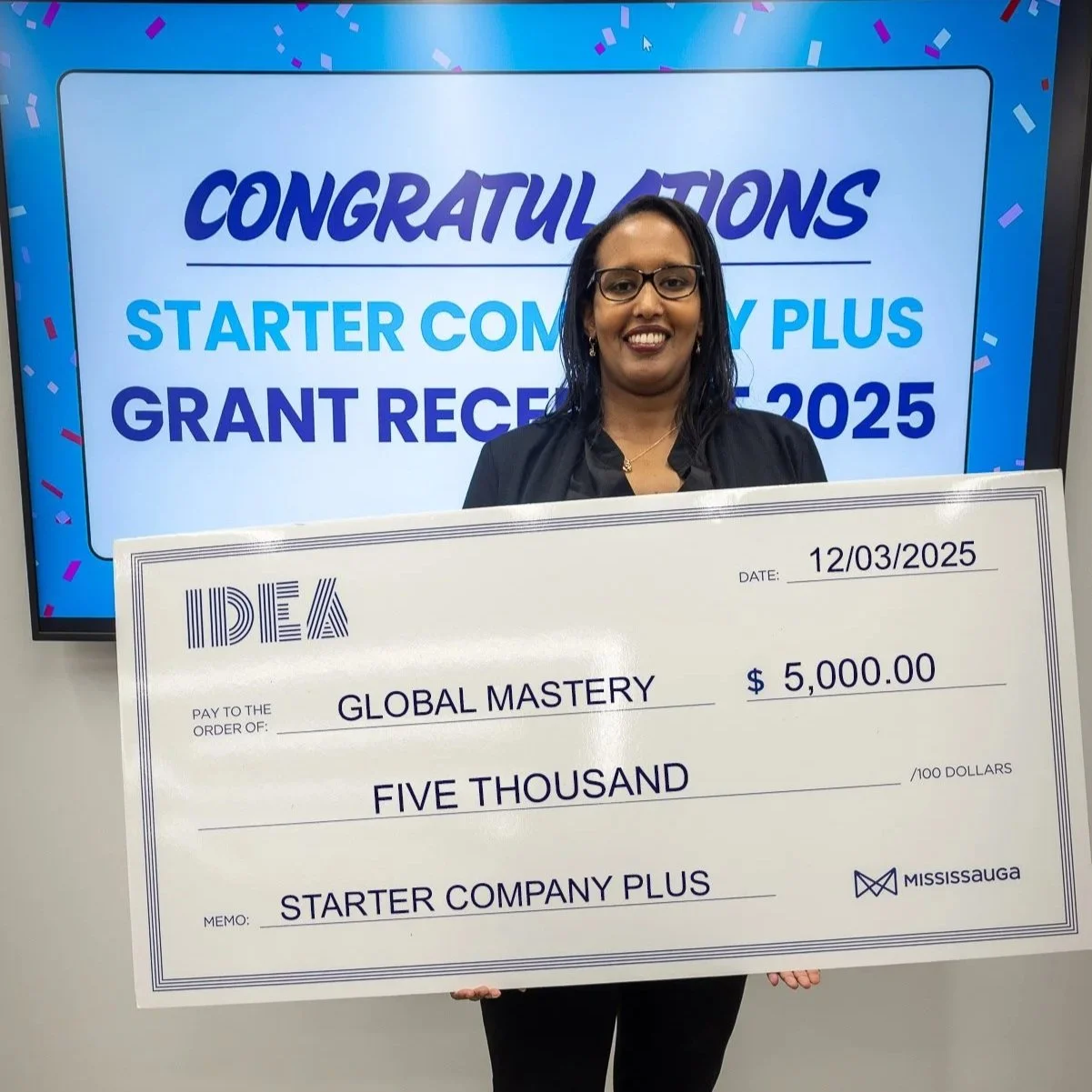
7. How did the Mississauga Starter Company Plus program help you start or expand your business?
The Starter Company Plus program gave me more than funding—it gave me structure at a critical moment. When you're building something from lived experience and industry expertise, it's easy to stay in your head. The program forced me to articulate my business model clearly, pressure-test my assumptions, and connect with other entrepreneurs navigating similar challenges.
Mississauga is Canada's sixth-largest city with a highly diverse population. I live here, I'm building roots here, and the city has programs supporting exactly what I'm building. Local presence lets me pilot faster, create case studies, and hire locally before scaling nationally.
The mentorship and structure helped me refine my approach before bringing it to market. For anyone considering the program: take it seriously. Show up prepared. The resources are there, but you get out what you put in. I'm grateful for the foundation it helped me build.