
Remembering Three Women From Historic Mississauga
/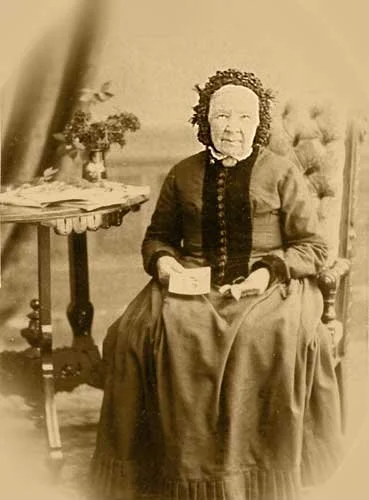
Sarah Wright.
Looking ahead to International Women’s Day (March 8) and to St. Patrick’s Day, we will explore the stories we know about three early Irish-born women with ties to historic Mississauga.
In the earliest years of settlement, several women came to own property here. One of our earliest known land grants dates to May 19, 1807. In it, The Crown granted 200 acres (Lot 10, Concession 1, SDS) to Sarah Grant. Sarah was born in Tullamore, Ireland circa 1764. We currently have no additional information on why Sarah received the land grant and not her husband. Given that many early settlers had either Loyalist or military service connections, there may be a similar link here relating to why Sarah received a grant. One wonders if Sarah may have been widowed between the time that land was applied for and she had remarried prior to receiving the land grant. We do not know. In modern terms, her land grant was south of Dundas Street near modern Cawthra Road. A mere 8 days after Sarah received her land grant, her husband, Amasa Grant of York (Toronto), sold the property. In a male-centric colonial culture, even though we know little of her life, Sarah represents a rare documented example of a woman being a recipient of a land grant here in historic Mississauga.

Crop of Property Abstract for Lot 10, Concession 1, SDS showing 1807 Patent to Sarah Grant.
Our next person of focus is Sarah Campbell McIvor. She was born on July 12, 1800 in Londonderry, Ireland to Jane and Dunkin Campbell McIvor. She married John Wright, also of Londonderry, in 1818. In 1833 they emigrated to Canada with their three children, settling in York (Toronto). The family grew to include three more children. In January 1838, Sarah’s husband John was killed after falling from his horse (he was serving the Crown in the aftermath of the Rebellion of 1837). Sarah was left on her own with a young family, including a child who was on the way.
As a widow, she had a small military pension, and in 1854 Sarah acquired a 5-acre property south of Streetsville along Mississauga Road (part of Lot 3, Range 5, Credit Reserve) and established a small farm. Her eldest son Samuel rented a larger farm property nearby. Sarah’s children included Jane (1819-1914), Samuel (1820-1924), Elizabeth (1832-1909), John (1834-1894), Mary (1836-1837) and Alexander (1838-1906). Sarah’s daughter, Elizabeth married into the notable Graydon family of nearby Streetsville. Elizabeth’s husband, William Graydon Jr., was the brother of prominent Streetsville builder John Graydon. Sarah sold her 5-acre property on Mississauga Road to her son Alexander in 1894, although she lived on the property for the rest of her life. Sarah passed away on February 14, 1902 at the age of 102 and was laid to rest in St. Peter’s Anglican Cemetery in Erindale. Sarah Wright was remembered as a fierce protector of her family and worked hard to ensure that her children would thrive and have security, despite the absence of their father.
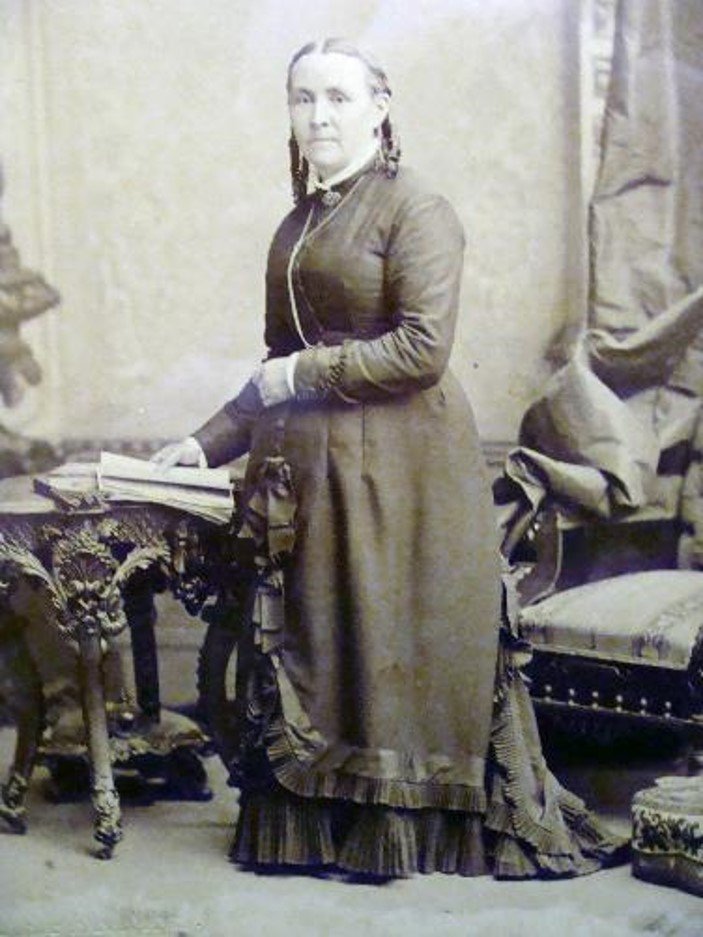
Matilda Cornwall.
Lastly, for this article, we will look at Matilda (nee McCleary) Cornwall. Matilda was born to Sarah and William McCleary in Roscommon, Ireland in 1835. In 1836 her family came to Canada, settling nearby in Trafalgar Township, and later residing in Oakville.
On June 17, 1856, Matilda married Edward Cornwall (1795-1883). Edward has lost his first wife, Helen Adamson, the year before. Helen was the sister of Colonel Peter Adamson and Doctor Joseph Adamson from the Erindale and Sheridan areas of historic Mississauga. Helen left behind at least two young children when she passed – Helen (1847-1925) and Edward Jr. (1850-?).
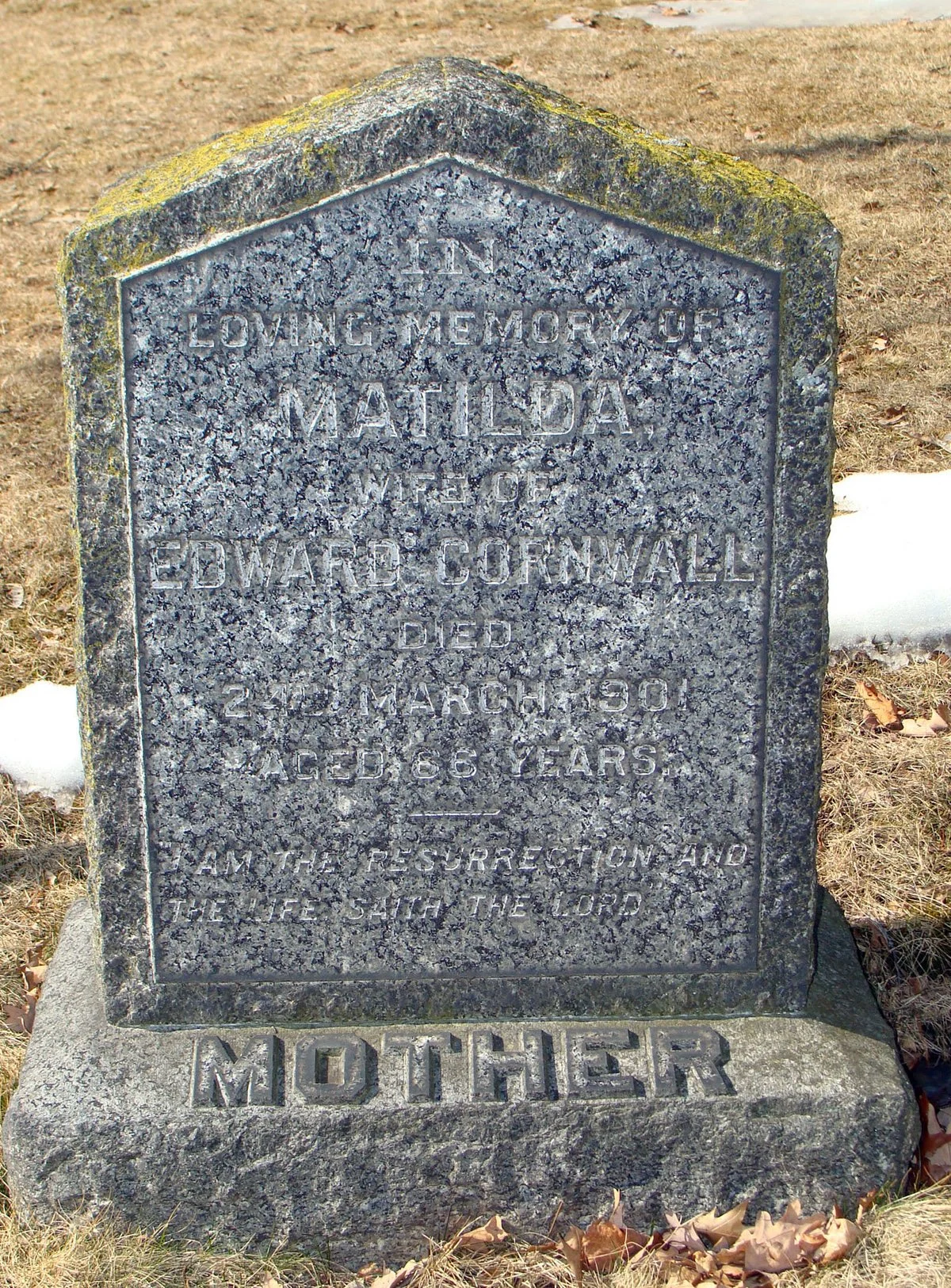
Matilda Cornwall gravestone, St Peter's Anglican Cemetery.
Matilda and Edward Cornwall would have at least five children together: William (1858-1925), Izet (1860-1880), George (1863-1931) Emily (1866-1940) and James (1869-1941). Matilda’s husband died on July 26, 1883 after 27 years of marriage. Matilda later resided in Erindale here in historic Mississauga with her son James. Matilda died on March 2, 1901 and was buried beside her husband in St. Peter’s Anglican Cemetery in Erindale. Interestingly, Matilda lived almost her entire life in the Victorian Era during the reign of Queen Victoria. While Matilda was significantly younger than her husband, she represented a cross-generational matriarchal presence for her family – she would have known her brothers-in-law, Peter and Joseph Adamson, and likely also Reverend James Magrath of St. Peter’s Anglican Church and the Harris family of Benares for example. She may have even known other early settling families such as the Bradleys, Clarksons, Cooks and Streets, yet because of her age she long out-lived those first generations, and in the process possibly became a source of stories and legacies being passed down to new generations that would call historic Mississauga home.
The perspectives, stories and lives of women in the annals of colonial history are seldom recorded in as much detail as men, but their voices and legacies matter, their lives helped to shape this place and their legacies are an important part of our history. Heritage Mississauga would like to wish our readers a Happy International Women’s Day.